Blocks: Back in the Spotlight Again

Every bit I load up my trunk with containers of blocks and plant materials in training for however another training for early childhood teachers, I tell myself that I am getting too former for all this schlepping. Just as quickly as the thought crosses my mind, a surge of excitement and free energy pulses through me. Afterward vi years of facilitating professional person development sessions on the exploration of materials with teachers, I am more convinced than e'er that blocks are one of the most essential materials for the early childhood classroom.
"Why then, in the proper name of school readiness, is cake play marginalized, if not disappearing from children'due south classrooms?" asks Margie Carter in the foreword to Creative Cake Play (Hansel 2017). Increasingly, young children today are sitting in forepart of two-dimensional screens and worksheets instead of having playful, hands-on, sensory experiences with three-dimensional objects (Hansel 2015). Why is this a trouble and what is it about blocks, and wooden unit of measurement blocks in particular, that make them such an important material for immature children?
Scientific Testify
Many early babyhood experts, including Friedrich Froebel, Caroline Pratt, Harriet Johnson, Elizabeth Hirsch, and Mary Jo Pollman, have documented the value of blocks for children'due south learning, offering prove that when children are given time to plan, construct, and create with blocks, they develop socially, emotionally, cognitively, and physically (Hansel 2017, 5). This evidence is at present being confirmed past scientists using new technologies to see the inner workings of the encephalon.
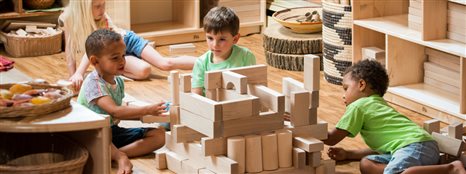
According to Dr. Jo Boaler, a professor of mathematics educational activity at Stanford Academy, brain enquiry now shows that as you learn something deeply, the synaptic action in the encephalon will create lasting connections (dissimilar when you learn something in a superficial fashion) and that "synapses burn down when we have conversations, play games, or build with toys" (Boaler 2016, i). In other words, building with blocks to experience their three-dimensional properties volition create a lasting pathway in the brain and a deeper understanding of shape, whereas identifying 3 dimensional shapes on a workbook page is unlikely to build agreement of shape and three-dimensionality.
The Importance of Spatial Skills
In addition, there is exciting new evidence linking expert spatial skills and children'due south future achievement in all the Stalk (Scientific discipline, Engineering, Engineering science and Mathematics) subjects (Lubinski 2013; Newcombe 2010). "Despite the show, however, the importance of spatial skills is ofttimes disregarded as a key feature of Stem pedagogy. This frequent fail of spatial development creates an additional bulwark to children's Stem learning" (Berkowicz and Myers 2017) and reminds those of united states in early childhood education that we must start paying attention to developing spatial skills. While laying the foundation in the STEM subjects is important, especially for underserved populations and those underrepresented in the Stalk fields, including girls, spatial skills are critical in many other fields, equally well as in everyday life, such as when we load upwards a torso with blocks and navigate our way to a new location for the first time.
The dandy news is that spatial skills can be improved with practise. While not all experts agree on a common definition of what spatial skills are (Hansel 2017, 20), most concur that the use of manipulatives helps children make sense of abstruse concepts. Wooden unit blocks are a perfect instance of a kid-friendly manipulative that can be used to strengthen spatial skills. Think virtually how a kid recreates a zoo with blocks while closely referring to a map of the zoo and carefully ensuring that each zoo animal fits into the enclosures she has made to scale.
Isn't information technology fourth dimension to put blocks back in the spotlight once again?
First with giving children ample fourth dimension for open-ended exploration with blocks, but don't stop there. If you really want to see children'due south spatial thinking flourish, target the spatial skills in the table below and offer block activities that encourage spatial language and challenging tasks! Now the spotlight is on y'all!
Reprinted with Permission: Regan Hansel, Rosanne. "Blocks: Back in the Spotlight Again!" Educational activity STEM with Ramps, Community Playthings, 5 Sept. 2017, www.communityplaythings.com/resources/manufactures/2017/blocks-back-in-the-spotlight.
References
- Berkowicz, Jill and Myers, Ann. "Spatial Skills: A Neglected Dimension of Early Stalk Education." Retrieved on June 27, 2022 at http://blogs.edweek.org/edweek/leadership_360/2017/02/spatial_skills_a_neglected_dimension_of_early_stem_education.html
- Boaler, Jo. 2016. Mathematical Mindsets: Unleashing Students' Potential through Creative Math, Inspiring Messages and Innovative Teaching. San Francisco, CA: Jossey-Bass.
- Hansel, Rosanne. 2017. Artistic Block Play: A Comprehensive Guide to Learning through Building. St. Paul, MN: Redleaf Printing.
- Hansel, Rosanne. 2015. "Bringing Blocks Dorsum to the Kindergarten Classroom." Young Children 70 (1):44-51.
- Lubinski, David. 2013."Early Spatial Reasoning Predicts After Creativity and Innovation, Especially in Stem Fields." Science Daily. July xv.
- Newcombe, Nora. 2010. "Movie This: Increasing Math and Science Learning by Improving Spatial Thinking." American Educator, Summer 2010, 29-43.
- Pollman, Mary Jo. 2010. Blocks and Across: Strengthening Early Math and Science Skills through Spatial Learning. Baltimore, Doctor: Brookes.©
Share This:
Source: https://www.4-c.org/play/blocks-back-in-the-spotlight-again/
0 Response to "Blocks: Back in the Spotlight Again"
Post a Comment